Organizations heavily depend on the IT infrastructure to drive innovation, strategy and stay competitive in the business. Being able to quickly adapt to shifting market demands and harness new innovations is critical for sustainable growth. Yet, traditional approaches to enterprise resource planning (ERP) often resulted in complex, heavily customized systems — creating what’s known as technical debt: the hidden cost of maintaining and upgrading these modifications.
- What is SAP Clean Core?
- Why Prioritize SAP Clean Core?
- Navigating the Key Dimensions of Clean Core
- Embarking on Your Clean Core Journey
- Debunking Common Myths
- Final Thoughts: Building a Future-Ready ERP
- References
SAP Clean Core methodology is a modern approach designed to keep SAP S/4HANA systems agile, upgrade-safe, and innovation-ready. In this guide, we’ll explore what SAP Clean Core is all about, why it matters for future-ready businesses, and how you can start your Clean Core journey in SAP S/4HANA Cloud.
What is SAP Clean Core?
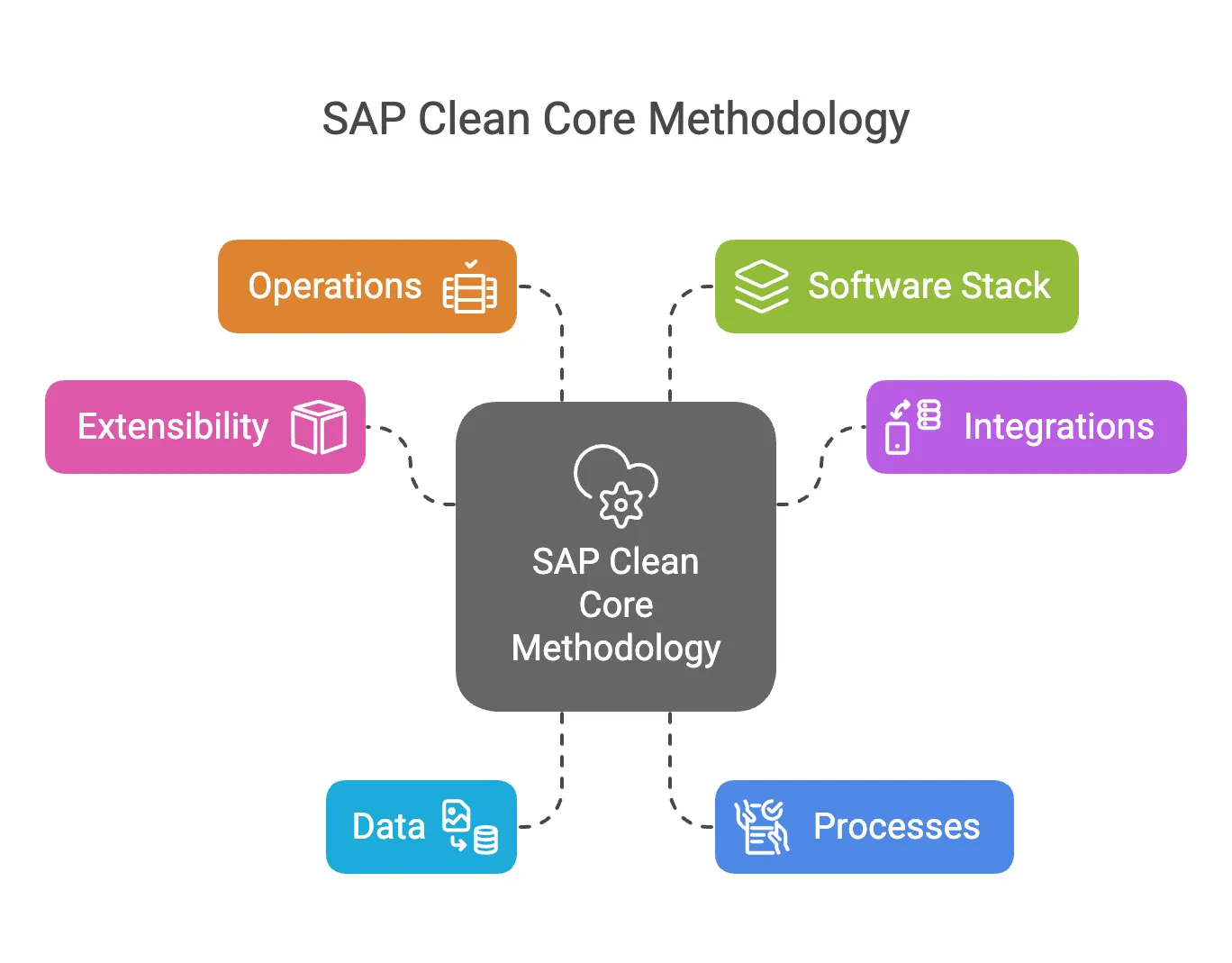
At its core, SAP Clean Core is a methodology for designing, building, and operating SAP systems with minimal modifications to the standard software. But it’s not just about technology — it takes a holistic view across several key dimensions:
-
Extensibility: Building business-specific functions in a cloud-compliant way, without changing the core.
-
Integrations: Connecting SAP and external systems using stable, supported interfaces.
-
Data: Keeping your data landscape lean, consistent, and high-quality.
-
Processes: Following best practices and strong process governance.
-
Operations: Running systems efficiently and reliably.
-
Software Stack: Keeping your software aligned with SAP’s latest standards.
A “clean” core is up-to-date, transparent, unmodified, consistent, efficient, and cloud-compliant.
The “core” refers to the fundamental elements of your ERP landscape: extensibility, processes, data, integration, and operations.
Why Prioritize SAP Clean Core?
Moving to a Clean Core brings a wide range of benefits that directly impact agility, innovation, and growth:
-
Greater Agility and Flexibility: Quickly adapt to changing needs by building new capabilities without disrupting the core.
-
Faster Time to Value: Roll out new functionality faster and meet evolving business requirements.
-
Access to Innovation: Seamlessly adopt new technologies, including AI, through safer and easier upgrades.
-
More Efficient and Secure Operations: Lower maintenance costs and improve system reliability.
-
Turning Data into Value: Unlock insights with a clean and consistent data foundation.
-
Stronger Resilience and Cybersecurity: Reduce risks with a more stable, secure system.
-
Simplified Technology Management: Move toward a scalable and manageable technology model.
-
Better Employee Experience: Free up employees to focus on high-value work instead of wrestling with outdated systems.
Ignoring Clean Core principles can lead to major challenges:
-
Slower Innovation: Technical debt slows down your ability to adopt new technologies.
-
Higher Costs: Complex, duplicated systems increase maintenance, upgrade, and infrastructure expenses.
-
Increased Risk: Unstable systems, skills gaps around customizations, and higher vulnerability to cyber threats.
-
Operational Impacts: Disconnected systems and poor data integration hamper decision-making and supply chain visibility.
Navigating the Key Dimensions of Clean Core
1. Extensibility: Building the Right Way
When it comes to Clean Core, extensibility is often the first thing that comes to mind.
The golden rule? Avoid modifying SAP standard code wherever possible. Instead, build cloud-compliant extensions that stay upgrade-safe.
SAP provides several extensibility options:
-
On-Stack Extensibility: Develop within SAP S/4HANA using cloud-ready tools:
-
Key User Extensibility: Leverage low-code/no-code tools for UI tweaks, custom fields, and simple business logic.
-
Developer Extensibility (ABAP Cloud): Write ABAP code following cloud-specific guidelines. The ABAP RESTful Application Programming (RAP) model is key here.
-
-
Side-by-Side Extensibility on SAP BTP: Build decoupled apps and services on SAP BTP, integrating with your core SAP system through stable APIs.
When building, always prioritize released SAP APIs. If necessary APIs aren’t available, Tier 2 extensibility — wrapping stable but unreleased APIs — is an option. Missing APIs? Submit requests via the SAP Customer Influence portal.
Make use of tools like ABAP Test Cockpit (ATC) with cloud readiness checks, and follow SAP’s three-tier extensibility model (Tier 1: Cloud-ready, Tier 2: Wrapped classic APIs, Tier 3: Classic ABAP).
2. Data: The Foundation of a Clean Core
A clean core starts with a lean, accurate, and consistent data landscape.
Focus areas:
-
Data Volume Management: Retire outdated data to lower costs and complexity — especially during cloud moves.
-
Master Data Governance: Use solutions like SAP MDG to improve data quality and governance.
-
Data Integration: Create a unified business data fabric with tools like SAP Datasphere.
3. Integrations: Connecting Your Ecosystem
For modern integrations, standard SAP APIs and event-driven designs are the way to go.
Avoid tightly coupled methods like RFC and IDoc when OData and web services are available.
SAP Integration Suite provides everything you need — and don’t forget to check the SAP Business Accelerator Hub for ready-to-use content.
4. Processes: Streamlining for Success
Strong process governance is critical:
-
Map and document processes.
-
Identify opportunities for standardization.
-
Use tools like SAP Signavio for process mining and optimization.
5. Operations: Ensuring Reliability
Reliable operations are a must for Clean Core success:
-
Assign clear responsibilities for upgrades and maintenance.
-
Manage releases systematically.
-
Establish effective housekeeping practices.
-
Use SAP Cloud ALM to streamline cloud and hybrid operations.
Embarking on Your Clean Core Journey
Getting to a Clean Core isn’t a one-time project — it’s a strategic journey.
Key steps:
-
Challenge unnecessary customizations.
-
Understand your starting point and non-compliant elements.
-
Establish Clean Core governance early.
-
Use SAP BTP for innovation.
-
Minimize complexity and maximize standards.
Tools like the Clean Core Dashboard and custom code analysis will help you track progress.
Depending on your needs, your path might involve a greenfield (starting fresh) or brownfield (cleaning up your current system) approach.
Debunking Common Myths
-
Myth: BTP is the only path to Clean Core.
Fact: A mix of on-stack and side-by-side extensibility works best. -
Myth: Clean Core only concerns custom code.
Fact: It spans data, processes, integrations, and operations. -
Myth: It’s just about lowering TCO.
Fact: It’s about enabling innovation, resilience, and agility too. -
Myth: Fit-to-standard is the only answer.
Fact: Cloud-compliant extensions give you the flexibility you need.
Final Thoughts: Building a Future-Ready ERP
SAP Clean Core isn’t just a technical initiative — it’s a strategic move toward a more agile, resilient, and innovation-ready future.
By embracing its principles and making Clean Core an ongoing priority, you’ll build an SAP landscape that’s easier to maintain, faster to evolve, and better equipped to support your long-term business goals.
Start your journey today — and set the foundation for a future-proof ERP.